Showing posts with label Korean. Show all posts

Saturday, July 25, 2009

Garlic chive and cucumber, Hot and cool, rescue for the summer night

We have not been blessed with such delight, but it is often too hot to do anything in summer. So, here is one quick dish doesn't require any heating.


Few days ago, I got garlic chives and cool cucumber. Cucumber is so fresh, it is almost sweet. Chive is pungent, it has too precious to be heated. So, here it is.


This is quick form of kimchi called "Gutjulee". The word Gutjulee means salting before other seasonings as a part of preparation. It also means kimchi intended to be eaten fresh, like very spicy salad.


Garlic chive gutjulee is often served with meat dish such as Korean BBQ. Meat dish in Korea is rarely eaten by itself. It always have greens served with, often spicy, to cut the heavy taste of meat.


But I found this serves very well with many other things including tofu. Tofu has subtle taste so goes with anything that it gets. Heat up tofu in microwave for a min and eat it with Kimchi or Gutjuless to go with. Very fast, very good, not to mention, guilt free.


Recipe


serves 4 as main dish


Two package of firm tofu,

one cup of garlic chive, chopped in two inch length

one cucumber, skinned and cut into strips

1T toasted sesame seed

1 1/2 T soy sauce

1t or up to taste, Korean chili pepper flak**

1/2 t sugar (optional)


1. Mix soy sauce, chili pepper flake, sesame seed and sugar. Let it sit for at least five minutes.

2. Mix cucumber and garlic chive. Let it sit in the refrigerator for thirty minutes. It would first look have too little moisture but cucumber will soon let its water out, making dish just enough.

3. Slice tofu block in half length wise and cut each halve into five to six pieces. Heat it for one minutes.

4. Serve together.


** if not available, use chipotle or cayenne pepper. Wasabi (Japanese horseradish) also works well. use about 1/4 t or add up to your liking. If you have none of these, add arugula. The point here is sharp spicy flavor.

Friday, May 15, 2009

Beachu Kimchi - Korean Buddhist temple style

Korean Buddhist temple food is recent discovery even for many Koreans. The food from Buddhist temple has distinctively clean taste without punch of garlic.

Here is one of recipe I used to make Temple style kimchi for my vegan friend.

2 Napa cabbage(about 5-6 lb), Daikan radish 2lb, 3 dried shiitake mushroom, 1 piece of konbu 2 inch by 2 inch, 1/4 apple, 1 small Korean pear, 2 inch piece fresh ginger, 1 cup of cold water, 1 Tb of sweet rice powder, 1/2 C Kosher salt + 2T salt, 5-6 Green onion, 1/4 C Korean chili flake

1. Wash and quarter in length the Napa cabbage
2. Pickle Napa cabbage by sprinkling 1/2 cup of salt; make it sure that the salt is sprinkled in between layers of leaves. Let it sit for at least 6 hours.
3. Wash off excess salt and squeeze the cabbage well
4. Pour 1 cup of water in sauce pan with Konbu and lightly washed shiitake mushrooms. Let it sit for 30 min-1 hour. Take out mushroom and squeeze and slice it very thin. Discard the konbu (or dry and reuse it for other dish). Add sweet rice powder and mix well. Put it on medium heat and keep stirring until it thickens and slightly transparent. Remove from heat and let it cool down.
5. Skin ginger; chop them by pulse it in food processor. Same goes for apple and Korean pear.
6. Add apple, pear and ginger in rice porridge (from 3) along with chili flake and 1-2 Table spoon of Salt; set it aside
7. Cut white radish in thin strips (about 2mm thick and 5mm wide); cut green onion in same length (halve the white part if it is thicker than quarter inch)
8. Wear gloves and mix chilli, apple, pear and ginger paste (from 6), green onion, mushroom and white radish in big mixing bowl
9. Take one quarter of Napa cabbage and rub the seasonings around it. Take small amount of mixture, rub and put in between every leaves. At the end, gently band the cabbage into half. Repeat till all the cabbages are seasoned
10. Put little bit of seasoning on the bottom, tightly fit the cabbage quarters and seal the container tight. When you put cabbage in, make it sure the container had at least 1-1.5 inch room between the top ob cabbage and the container cover since remaining water from napa cabbage will come out as kimchi sits.
11. Let it sit on counter top for a day and put it in the refrigerator.
12. Give it at least week to develop the flavor.


** The container you use, now on, must be Kimchi container. Even though garlic is not added, still the container can hold on to the smell. So, choose your container accordingly.
** I found the napa cabbage in US has more watter than Korean one. So put a tray under the container for 3-4 days just in case water developes and ...you know, leak out. :)

Monday, February 9, 2009

Day of Five grains and nine herbes, Deaboreum


Moon dictates agricultural cycle. Lunar calendar, therefore, was very important one in the past. Koreans still follow lunar calendar closely for celebration of the year. Ancestral ceremonies and birthdays in traditional family is celebrated according to Lunar calendar. New years day is not the new years day of western calendar. The real celebration begins with January of Korean lunar calendar, which usually falls around February in western calendar. In the past, the new year's day continued till the first full moon of the year.

This year, the first full moon of the New year, called Daeboreum (the word means great full moon) was yesterday. This is the official end of New Year’s celebration.
In the night, while you are greeting the new moon, fire is lit on the dried bank of rice field to prepare for the new rice season.
Food, like all other traditional Holiday, takes important place in this day.
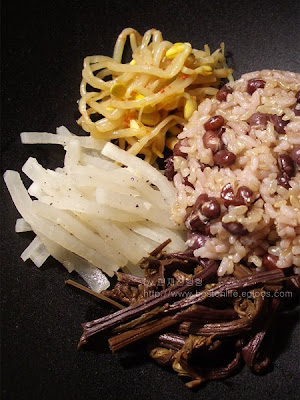
‘Ogokbahp’ (Ogok: five types of grains and beans, bahp: steamed rice) and nine types of special ‘namool’ made from dried herbs and vegetables is made for the day. Depending on region, the rice and namools are rolled in kim, (dried seaweed, AKA nori) and offered as offering to the ancestors wishing for good harvest and good year.

I made it for the day, too. (It was one day after, to be exact, due to the dissertation committee meeting this morning.) Even though I only used three ingredients for rice and made only three ‘namool’s to go with, the effort and taste counts.
I showed off my skill to my Mother, Grandma, and aunties who all see me as a child even though I am adult. Their praise and sweet happy surprises gave me childlike pleasure: the kind of pleasure that a young child would feel when her parents clap and praise for the first drawing she did. I was proud and happy.

One warning! If you have Korean friend, don’t answer their call Daeboreum. They may sell you their Duwi (meaning heat of Summer, symbolizing misfortunes or illness for this year due to the heat of Summer), which you don’t clearly want. The line, “Nea Duwi Sala!” means you just bought my Duwi for the year. I got tricked several times, and resell my misfortune to the other. If you happen to be the last person to ‘buy’ all the heat of the summer, then your salvation is kite. My father told me to write down my name and let it float away with my misfortune.


Ogokbahp

my version is short, uses ingredients easy to get. :)
for two people,
small red beans (known as pat or azuki) 1/4 cup, 1/3 cup of short sushi rice, 1/3 cup of brown sweet rice, water
1. soak red beans over night in one cup of water. Drain and rinse, add a cup of water and boil till it gets half tender.
2. soak brown sweet rice for one hour.
3. mix red beans, sushi rice, and brown rice. Add 1 and 1/4 cup of water. Boil it over high heat with cover. Uncover when it is about boil over. boil till there is no visible water. (DOES NOT mean DRY, though) Put the lid back on, reduce the heat as low as possible, and let it steam for 25 min.

Namools

From the top, Kong namool (soy bean sprouts namool), Moo namool (white radish namool), and Kosari namool (bracken namool)
If you go Korean market, you can get namool. Namool means simple vegetable dish sometimes it is a bit time consuming. Many poeple are more than happy to buy it. But here is recipe, just in case.

Kong Namool or Moo Namool

1 lb of soybean sprout or white Daikan radish, one teaspoon of sesame oil, half clove of minced garlic, salt and pepper to taste

option: finely chopped green onions, toasted crushed sesame seeds, Korean chili flake
1. Rinse soybean sprout. If you are using moo(white Daikan radish) cut it into very thin strips as you can see above.
2. In the sauce pan with lid, heat one teaspoon of toasted sesame oil over high heat with garlic. when the garlic begins to bubble (which is usually right away), add main ingredient, stir well, reduce heat to medium-low, cover and cook for 10 min. When you use soybean sprout, you should NOT lift lid before soybean sprout is fully cooked.
3. Turn off the heat,
4. If you can get, season it with pepper and Korean fermented fish sauce. If you can't, just use salt and pepper. You can add green onion, sesame seed or Korean chili flake.

Kosari namool (dried Bracken namool)

This is a typical example of labor and time consuming Korean food. But it is not that complicated.
2oz of dried bracken, water, one teaspoon of toasted sesame oil (Perilla oil is preferred choice but it can be little hard to get), 1 tablespoon of say sauce, half clove of minced garlic, pinch of pepper
1. Soak bracken for thirty min. Rinse and put it into the pot with plenty of water.
2. boil it over medium low heat for 40 min.
3. Leave it till it is cooled.
4. squeeze all the excess water out. Chop it into desirable length.
5. heat oil and garlic, add chopped bracken, stir in say sauce and pepper.
6. Cook it for five min. Cover and let it sit for 10 min.
Add toasted broken sesame seed if you want.

Saturday, February 7, 2009

Breakfast in my youth, Kong-juk


My mother used to make it fresh for breakfast for the rest of family, even though it usually was not the first thing in my mind. During the high school years, I studied to death to enter good university. I went bed late and school hours were very early. By the time I got up, I was not a happy child. I took it out -as often the teenagers do, if that could be an excuse- to my mother, who also stressed out about her work and many other things but never took it out on me.
My mother never skipped to make breakfast even though she also had to run to her work. I was never allowed to go school without eating breakfast. At least, I had to drink freshly boiled and ground soybean porridge. I didn't appreciate it back then, but now I admire my mother with full heart. Soybean is not something fast to cook. She soaked beans overnight, boiled it tender from early in the morning, and ground it smooth for her lazy daughter.

Same broth is used to make summer treat, Kong-Guksu. These days, you can take shortcut by ground tofu instead.

But I did it very old fashioned way. I was missing my Mom. I need the little texture that only the ground soybean. So I soaked, boiled, and ground it with little bit of rice. Seasoned the mixture with doenjang, pepper and dried anchovy powder.
Two different status of soybean (boiled soybean and fermented soybean paste) make very unique taste.

I ate it with spacey green chili pickle I made earlier in late October. The snow covered outside makes me appreciate what I ate and what I had eaten.

for soaking
1/4 cup of dried soybean, 1cup of water, 1/4cup of short grain rice, 1cup of water

for porridge
3 cup of water, one table spoon of Korean soybean paste, 1/2 teaspoon dried anchovy power (if you don't have it, you can use bonito flake, even though it will give totally different taste), 1/2 teaspoon of pepper

1. wash soybean and rice and soak separately, in one cup of cold water overnight in the refrigerator.
2. Boil soybeans till it is tender. Grind it with soaked rice.
3. return to the pan and add three cups of water
4. boil the mixture till rice is cooked. Stir in order to prevent the bottom from burning.
5. Mix soybean paste with one table spoon of water very well. add it to the pan and stir.
6. mix anchovy powder and round black pepper. adjust seasonings with salt if necessary.

Kimch & Korea, shame and fame


As I wrote in previous article, I choose the days I eat Pakimchi even though I adore it. It smells even after eating scallions. The compound in scallion family is absolved into blood and circulates around the body. The compound then comes out through lungs when we breathe out or leeks out when we sweat. So whatever you do -brushing teeth about million times and gargling with gallon of mouthwash after eating row lots of scallions or garlic- IT DOES NOT WORK!! The problem is in your blood!


This was one other reason why Kimchi, the national dish of Korea, was notorious. It has a ton of garlic. When it doesn’t have garlic, such as Pakimchi, it has Pa(scallion), vegetable which is equally strong and smelly.


Kimchi itself has quite a smell like many other good things just from its fermentation process; good cheese stings, if you ever notice it. Even many Koreans do not like the smell of fully ripen Kimchi.

Kimchi is one food that has been shamed and famed with Korea.
During the Japanese occupation, Japanese looked down upon Kimchi like all other Korean culture. Now Kimchi and many other Korean foods become very popular even in Japan. Japanese come up with many items using Kimchi and other food with fresh ideas which they are very good at. This adapting for desirable foreign goods and customs and creating new things out of it is called –iitokotori (良いとこ取り).

Looking how the perception of this food changed around the world gives me bitter sweet feeling. I am happy that finally my favorite food gets the acknowledgement it deserves. I am a bit sad that it may loose its origin 'Korea' since Koreans are not necessarily quick to think to commercialize and to develop products out of things what we own.


Kimchi is pungent and strong. It is expressive and explosive like Koreans. Even though it is often considered not polite, in Korean culture, it is totally fine to express your overwhelming joy and sorrow in public. The big loud laugh, the tears running like river, screams of joy from your inner little child and moaning coming out of the tattered soul, all in public, are acceptable. It just says you are human, after all.

Back to the issue of smell, the best way avoid it is not to use garlic or scallions. If you want to avoid using garlic and/or scallions, feel free to go ahead and do so. Kimchi can be fermented without any of them. It just add flavor. How do I know? I make Kimchi without garlic using Korean Buddhist recipe. Buddhist monk does not consume any vegetable that has strong taste since it stir up passion. They want to remain calm and focused. I will translate (hopefully soon enough) few of my favorite Korean Buddhist recipe into English.

Pakimchi - I am pakimchi! :)


'Pa' means scallion in Korean. Like all other vegetable, Koreans make Kimchi out of it. I guess this is the most difficult Kimchi to appreciate for non-Koreans. Scallion can be used as alternative for its milder cousin, chives. Koreans treat chives as vegetable. Chives are cheap, little bit more tedious to clean, and milder. Whenever you see chives in Korean recipe, it can be almost always substituted with scallion.

Few days ago, I bumped into bunch of fresh tender delicate scallions which is rare finding. This is the perfect size of one of my favorite Kimchi. Kimchi is usually named after its main ingredient. Pakimchi mean Kimchi made with scallions.
It is so simple to make. I don’t need even cure the vegetable or make starch to make base for the seasoning. I simply mix Korean red chilli flake with little bit of sugar and Korean fish sauce.
The taste is as you imagined: scallion is very pungent. Imagine adding ton of spicy red chilli flake. Even though the pungent taste of scallion will reduce little with time, but it remains as scallion. This burn-your-mouth-spicy Kimchi over well-made hot boiled rice is my soul food.
Koreans often say “I become Pakimchi” meaning “I am so worn out, so I can not even sit strait.” You can easily understand the status by imagining the cooked whole scallion: it become very soft and has no strength to hold its shape. I was that shape when I found perfect scallions for Pakimchi. Just thinking about it gave strength!
I happily made Pakimchi and waited few days for it to be soak up and mingle with the simple seasonings. I consumed it, felt its full powered punch to my nose and tongue, and came out of ‘being Pakimchi’.

25~30 Scallions, three table spoon of Korean chilli flake, one table spoon of salt, two table spoon of Korean fish sauce (if you don’t have it, use one table spoon of salt + one table spoon of water), one teaspoon of sugar
1. Get scallions as thin as possible. Soak it in cold water for
2. Meanwhile Mix chilli flake, fish sauce and sugar and let it sit.
3. Remove scallions from the water and drain very well. Trim off the root.
4. Mix scallions with seasoning well in a big bowl (please use protection such as gloves!) and put it in a air tight container.
5. You can eat it right away with grilled meat or let it sit for three days.

Wednesday, October 1, 2008

Food for soul - Yoenghun Jorim, Lotus root in soy sauce

Lotus grows in mud but blooms the flower of heaven. That is what the Buddhist teaching taught me. We are always in the world of deceptions, the world that as murky as mud. Yet, our soul can bloom a beautiful flower of heaven, our deed can be as white as a locus blossom.
Besides of its beauty and its valuable teaching, every part of lotus has many usage. The lotus nut makes delicious snack and has calming effects on nervousness. The blossom has used to perfume the rice wine. Leaves make fragrant tamale-like steamed sweet rice. The stem and roots, rich in fiber, are eaten through out the Asia.

I slowly simmered it in soy sauce along with ginger. I didn't like lotus root that much when I was young child. It is one of the food that , I thought, did not have much taste.
I discover now, it actually have subtle but very distinctive taste like the way potato does. I can not put my finger on it, but something is there to taste.
The root is quite hard and take some time to be fully cooked. But I think the wait is all worth it whenever I bite into it.
Recipe
Lotus root 1 lb, 2 Table spoon of vinegar + 2 cup of water
Say sauce 1/2 C, water 1 + 1/2 C, honey 1 T, dark brown sugar 1 T, whole black pepper 1/2 t, sliced fresh ginger 1 T
1. Peel and slice lotus root into 5-7 mm thickness and soak slices in vinegar water.
2. Mix soy sauce, water, honey, dark brown sugar, black pepper & ginger in sauce pan and bring it to boil.
3. Rinse & Drain lotus root slices and add them into the sauce pan. Put lid on top and reduce the heat to low. Simmer it till tender (about 30-40 min).

Thursday, September 18, 2008

Moon, more than a thousand year old song, and Bindeadduck (Mung bean pancake)


Back in high school, I learned about more than thousand years old song . It was song of a wife, waiting for her husband under the moon. She was asking moon to rise high enough, so her husband would see well on his way home. I loved the words for how it sounded. I loved even more to find out a lady who had same habit with me more than a thousand years ago. I often made a wish upon the moon waiting for my father to come back home in the evening.

Making wish upon the full moon is something older than this song. August 15th on Korean lunar calender, the day with the brightest full moon in the year is celebrated as Thanksgiving. There are many stories about how it began. This is the day when all of family members get together.

This year, I didn't go back. I called up my mother and relatives. Made wish for my brother. Remembered my late father and grandfathers. This was a bit of bitter sweet day for me. But certainly I made food to celebrate the day and made many wishes upon the moon. This cake brought a big smile to my housemate, who also misses her husband who is far away now. A thousand years later, we still look up the moon and look down to the moon-look-a-like. This warm pancake filled our heart as the full moon did the sky that day.


2/3 cup of dried mung bean, 2 cup cold water, 2 T vegetable oil, 1 t sesame oil, 1/8 cup mung bean sprout, 3 dried shiitake mushroom, finely chopped Kimchi 1/8 cup, 1/2 t minced fresh garlic, salt and pepper up to taste.

1. Soak mung bean in 2 cups of cold water overnight. In separate container, soak dried shiitake mushroom


2. Place bean in big and deep enough bowl and rob them between the palm, removing skin. After removing 2/3 of skin, add a cup of water and stir very gently (careful not to disterve beans at the bottom) with fine sieve, removing skin from the bowl.


3. In separate bowl, soak mung bean sprout and pour boiling water on top, let it sit for five min. Drain & finely chop it.

4. Gently squeeze shiitake and finely chop it.

5. Mix mung bean sprout, shiitake, and kimch with sesame oil, salt & pepper.

6. Blend soaked and drained mung bean in the blender. Add two table spoon or so of water if necessary. Mix blended mung bean with 5.

7. Pan fired the batter as you do with pancake using vegetable oil.

8. Serve warm with soy sauce.

Friday, August 15, 2008

Summer slips through with noodles - Kong Cold noodle in Soybean milk

Korean Summer is intense; the air is thick with heat and humidity, I felt as if walking in the water.
One thing my mother often makes during the summer is Kong Guksu, noodle in soy milk.
Each family has different way of doing it. Some family mix sesame, peanut or pine nut for flavor. I am use to just plane soybean milk with cucumber on top.
You can do it with plane soybean milk. It may be a bit of stretch for non-Korean that eating noodle in soy milk, but remember pasta in cream sauce? It is same concept. :)

I did it in traditional way; sock and boil soy beans, ground it as silky as possible and add salt & pepper. The process takes a bit long, but it is wonderful meditation for me.

The short cut for making broth is blend a table spoon of peanut butter, salt & pepper to your taste with plane cold soy milk in blender. Add cooked and chilled wheat noodle of your choice.

I didn't like this rather bland noodle. My taste was too young to appreciate it. Suddenly, after 30 and some more years, I discover it as if it is new food! Some times, good things take time to be appreciated.

Monday, August 11, 2008

Peang-ee & Aehobak Namool, Enoki mushiroom and Zucchini

I have an obsession; 'I gotta have it NOW' kind of thing; the thing that some girls can't resist; precious pretty vegetables!
I wonder who dare to say no to this lovely thing.

It is hard to avoid. Whenever I see new kind of vegetable or new form of known ones, I have to have it! This time it was baby zucchini. This precious little darlings are too good to miss.
But what can I do with it other than grilling to show-off its lovely shape and tenderness?


I wrapped around it with another my favorite, Peang-ee (AKA Enoki).
Baby zucchini has perfect width to wrap around delicate enoki mushroom.
Usual way I would cook Peang-ee and Aehobak Namool is slice zucchini in half moon shape and sautee it little bit with garlic, ginger, soy sauce and sesame oil for about 5 min or so, add enoki, turn off the heat, put a rid on the pan and wait for another 5-6 min. But I decide to make it little bit more elaborate.

Slice zucchini as thin as possible with Vegetable peeler and wrap it around enoki mushroom which trimmed in same length. Arraigned it on the oven safe plate and baked it in the oven for 7 - 10 min (more traditional way would be steamed in steamer but I choose little short cut).

Some times, arranging food in a little bit different way can result in big delight.

3 Baby zucchini, one bundle of enoki mushroom
half clove of garlic, 1/2 t fresh ginger, 1 t of sesame oil, 1 T of soy sauce, 1 T of Water or rice wine (or just white wine)


1. Preheat oven 380F.
2. Trim Enoki into about 3 inch in length. (the rest of edible part you can use it in miso soup or omelet.)
3. Slice zucchini as thin as possible with Vegetable peeler and wrap it around enoki mushroom. Wrap it as tight as you can since enoki shurinks after cooking. Arraigned it on the oven safe plate.
4. Mix grated garlic, grated ginger, say sauce and water. Spoon the sauce over the arranged zucchini and mushroom.
5. Baked it in the oven for 7 - 10 min with rid on.

Wednesday, August 6, 2008

Pure and Simple - HongHap Tang, Mussels soup

This would be food in its simplest form.
Pure water and mussels or clam, little bit of rice wine, salt and pepper, few green onion, and that's it. Fresh clam or mussels does not need anything else. The sweetness from fresh shellfish is sublime. If anything else is added, it would ruin the delicate flavour.

I was about seven or so. My baby brother about five. As soon as we hear the sound of mussel vendor, we ran to our nanny, begging her to buy a big pot full of steamed mussels. For us, a hot summer day treat was piping hot steamed mussels with little bit of broth. A bit unusual taste for a child, but I came from far south part of Korea, where was (and still is) various kinds of shellfish for every season. I was more used to eat fresh steamed clams, mussels and other shellfish for snack than candy.

I find Koreans, including me, are a bit of soup enthusiast. Boiled food has something that gets us going. The comfort I feel from hot broth is indescribable. Many often consider clear soup is poor food. It has nothing but watery broth. But sometimes, that is the whole point. The calming sensation is somewhat like taking warm beath.

for one person

1/4 lb mussel, 1 1/2 cup of cold water, 1 T rice wine, salt, pepper, and fresh green onion or chive

Clean mussel and place them in rice wind, pepper and 1 1/2 cup of cold water. Boil till all mussels are open. Season it with salt and garnish it with green onion or chive.

You can use small clam (vongola) instead of mussel.

Monday, July 28, 2008

pumpkin kimchi


It takes longer than I expected to write something in English for me, which humbles me greatly.
I hope my not-so-good writing does not deter your interest in wonderful food.
Here is one recipe that I have been writing.
You can read story about this dish at http://koreanfoodlife.blogspot.com/2008/03/sunday-lunch-family-style.html

And here is recipe that I promised Ahna.

Pumpkin 2 lb, napa cabage 2 lb, 5 Green onions, daikan radish 1lb, salt (kosher or sea salt with medium grain) 1/2C (for curing) + 2 T (for seasoning), Korean chillie Pepper plaque 1/4 C (can go all the way up to 1 C depending how hot do you want), Minced fresh garlic 2T, Minced fresh ginger 1.5T, Sweet rice flour 1.5 T, Water 1 C

The process is a lot like making kkakdugi.

1. Wash and draine napa cabbage. quarter it in length, and sprinkle 1/4 cup of salt and cover it with plastic wrap. Let it sit for at least 6 hours till it give out plenty of water.

2. Slice pumpkin into about half inch thick and cut 2 by 2 inch size. Transfer it into big stainless bowl and sprinkle 1/4 cup of salt. Mix well and let it sit for 30 minutes.

3. place 1 cup of cold water in sauce pan and stir in sweet rice flour. Place pan on medium heat and stir constantly till the rice flour is fully cooked. Let it cool down.

4. Cut green onions at 1.5 inch length both white and green part. Wash radish cut it into fine strings. First slice it into very thin disks, and then chop.

5. Wash napa cabbage and pumpkin with clean cold water and drain. Put pumpkin into the bowl, sprinkle half of chillie powder, and mix well.

6. In separate big mixing bowl, pour rice porridge and add the green onion, garlic, ginger, half of remaining chillie powder and salt, mix very well.

7. Chop napa cabbage in same size with pumpkin, and add it into the mixing bowl containing seasoning (step 6) along with pumpkin. Mix well. (Use protective globe to protect your hand from spicy chilli powder!!)

8. Put in tight-sealed container and let it sit for a day at room temperature. Keep it in the refrigerator.


** This kimchi tastes good even with not so sweet pumpkin.

Monday, April 28, 2008

cure for all - salted dried pollack soup Bukeo ghuk

Salted and dried pollack-which has several name depending on how and where it was dried- is hard as a rock. How hard? Well, it can be used as weapon or something that you can take all of your frustrations - such as a husband who was too busy hanging out with his friends and totally forgot about anniversary - out.
This soup is well-known as hang over cure.


Now back to the bad husband and his poor wife. The next morning, the poor wife goes to kitchen, finds the poorer dried cod, and beats the heck out of it. The beating tenderizes the fish and may also soothes the mood of wife. Wife serves the bowl of soup to now regretting husband. When he comes back from work that day, he may buy flower or little gift for his wife. No, I am not talking about my parents.... or am I?

Some times you don't need word. :)

These days, you can buy already well prepared and flaked fish in Korean market. The recipe is simple.


Perilla oil (deulgireum*) 1/2 T, salted, dried and flaked Korean cod (Bukeo or Hwangtea) 1/2 C, Half package of firm tofu cut into 6-7 pieces, one half package of soy bean sprout, 3 cups of water, one 2 by 2 inch piece of Konbu, Chinese leek (or green onion) halved and chopped in 2 inch length 1/4 C , salt and pepper, hot green chili pepper (optional)


1. Heat oil in the sauce pan and fry the cod flake little bit, add and soy sauce, and saute it little bit more.


2. Add water and konbu and boil. Skim over any foam. Boil about ten minutes.


3. Take out konbu and add leek (if you use green onion, add just white part now and set green part aside), tofu and soy bean sprout. Boil about five minutes or till the leek is tender.


4. add pepper and salt up to taste.


5. if you want to enjoy spicy soup, add halved green chili pepper just before serving. Add green part of green onion as garnish.


* you can find it in most of Korean market. If you can't you can substitute it with little bit of dark sesame oil.

Thursday, February 7, 2008

S, Segments & Streams: food for seaonal holidays

The seasonal food Koreans eat on the specific days functions as a gate that begins new season and ends the old; the signal that segmentation and succession of time. For instance winter solstice (Dong-ji, in Korean) is celebrated with Pat-juck, red bean soup.


Pat(Korean red bean, AKA azuki bean) is red; the color that symbolizes blood. Blood has been believed an essence of power and life. It drives all jealous evil which may lurk on good days to ruin the happiness. The color red also means 'yang': power of sun. Winter solstice is the day when the yang finally begin to grow. By eating this soup, Koreans wish for the growing yang to be stronger as the growing daylights.


The cellular structure of 'Pat' is unique. Each cell has thick wall which allows to be made into smooth pastes or fine powder once they cooked. This characteristic of Pat is fully appreciated and utilized in many sweets and savory dishes around North East Asia.
Pat-juck is usually savory in Korea. The sweetened version is called Dan-Pat-juck. ‘Dan’ indicates sweetness. It is served with both extra salt and sugar so each person can season it as they desire.
Smooth silky texture is both from finely grounded Pat and sweet rice which cooked in the soup. The simple soup is served with white sweet rice balls.
As child, I didn't like this soup. It was too hot, rice ball stick to teeth and was hard to swallow. The taste was rather bland to the child’s tongue But making it was fun. The rice ball is made by all of the household members. I remember making it with my parents and younger brother. It wasn't easy to form perfectly sized balls as my father's and mother's. But I insisted to have rice ball I made.
I made it the bitter cold wet & snowy winter day -an example what the New England winter can offer. The warmth of this soup -or porridge if you may insist- brings up Yang, the breath of spring Sun hidden somewhere waiting for the growing days.


New year's day -which same day with Chinese new years day - is called Seol-nal. The ancient Korean word 'Seol' means something pure and white; the end and the beginning.
This way is also celebrated with special food; Tteok-ghuk.
Tteok’ is various form of rice paste. For Tteok-ghuk, rice paste is made into stick shape and sliced thin. Tteoks are usually sweet but also used or made in savory dish. In most cases they are made with rice. Depending on occasion, various types of Tteoks were served and still are served.


When I was young, Seol-nal preparation began with trip to miler who would make over night soaked rice into rice stick. Freshly made rice stick was warm and chewy. It makes excellent snack for me and my younger brother. Our nanny –who was also worked as domestic helper for our family – brought still steaming bundle of rice stick to home. It was dried and sliced into thin oval shape.
In Seol-nal morning, the special soup, Tteok-ghuk was made with this sliced rice stick. Special broth had been simmered all day since the morning before. Depending on family, dumpling is added.
When we stayed at Seoul, my uncle’s family came early morning and we enjoyed family meal. Unlike holidays in United states are generally celebrated in the evening, Korean holidays begin early with ancestral ceremony.After the morning feast, I, my brother and two cousins would do Se-bea, a formal bow to the elders. In return, we got small amount of pocket money with blessing for the year.

Recipe

Pat-juck


Pat (Azuki bean) 1 cup
Sushi rice (or medium rice)
1 cup Water 4 cups + 2 cups
Sea Salt 1/2 T
Dark brown sugar 1 t

1. Soak washed bean in cold water for an hour. In separate bowl, soak rice.
2. Boil beans in 2 cups of water for 5 min. Through away water and add 4 cups of cold water, cook it on medium heat till beans are completely cooked.
3. Ground beans in blander finely. Add the water that the bean was cooked. (careful!! It is culinary version of lava!!) Sieve it with fine shiv over clean big stainless steal bowl. Through away whatever left on the sieve.
4. Return the liquid in stainless bowl into the pot. Add rice (removed from the water) salt and sugar.
5. Heat the pot on medium heat. Stir very well while it is on heat.
6. Add sweet rice balls when the rice is almost cooked.
7. Serve warm with extra salt and sugar.

For sweet rice ball
Sweet rice flour 3/4 cup
Boiling Water 4 T
Fresh Ginger, ground 1 t
Cinnamon, ground 1/2 t
Pinch of salt

1. Mix rice flour with Ginger, Cinnamon, and salt.
2. Add boiling water and mix well till it forms smooth paste.
3. Make it into 3/4 inch diameter ball. (about the size of quail egg)
4. Boil about 3 cups of water in a pot.
5. Cook 4-5 balls at a time in boiling water. It is cooked 1-2 min after it floats on top.
6. Spread them on coated cookie pan, cover them with plastic wrap after they cool down.
** They are very sticky. Do not let them stick to each other or the cookie pan.

Tteok-ghuk
Pre-sliced rice stick 2 cup - available in Internet or in Korean groceries
Water 5 cups
Soy sauce 1 1/2 T
Pinch of salt & Fresh ground pepper
Dried shiitake, 3-5
Dasima (Dried stalk sea weed, ) 3 inch by 3 inch, 1 slice
Garlic, minced, crushed or sliced (I prefer sliced ) 1 fat clove
Ginger, fresh, minced, crushed or sliced (I prefer sliced ) 1 t
Egg, large 1
Leek, washed through 1 cup
Sesame oil 1 t

1. Soak washed & stemmed shiitake and dasima in 5 cups of cold water.
2. Heat sesame oil, add leek, garlic, ginger. Stir and cook till leek is half cooked.
3. Add 1 with shiitake and dasima. After boil, reduce to lowest heat, and simmer for at least 30 minutes.
4. Meanwhile, soak rice stick slice for 20 - 30 min in cold water and remove before adding into the pot.
5. Increase heat, and when the broth boils, add rice stick slice. Cook till rice stick is fully cooked.
6. Remove from heat, add egg and stir.
7. Put it into serving bowl, add garnish, and serve warm right away.

** This is vegetarian version. For non-vegetarians, use ground beef if you desire. Season ground beef with soy sauce, garlic and ginger. Heat little bit of sesame oil, add beef and leek, cook till leek is half cooked, add water and boil.

Garnish
Kim komung (Nori garnish) - cut sushi nori into thin, short, same length strip
Egg garnish
Two large eggs, vegetable oil, pinch of salt
1. Separate yolk from white. Gently beat each with pinch of salt.
2. Heat gently vegetable oil in coating pan.
3. Pour egg white first. When the egg is half set, turn off the heat and cover the pan.
4. Remove cooked egg white and cook yolk in same way.
5. Cool it down and slice it or cut it into diamond shape.

The garnish is not just for the decoration. Nori flakes is a must!!

Friday, January 25, 2008

D, Desperation & Delicary - Poygobusut Kongnamool Bhab

I often think that the first person who ate many of the delicacy today was the most desperate one; the one at the blink of death by starvation. That person bumped into the strange creatures and vegetation after long and desperate walk to find something to eat. Now he faces new question; he would die if he doesn't try or he will die trying it. Being the first always has risk. For instance, Shennong, the mythical emperor of China, turn blue after trying all the plants to find out what effect it has -good or poisonous- on human. But, who knows? He may live if the creature or the vegetation which nobody had tried it is indeed good to eat despite their scary and strange look. The leap of the faith had been made. And now we have delicacy as result of ancestors' desperation and their spirit of never giving up.


Many good foods come from resilience of people facing the hardship. The ones who had never given up the desire for good life no mater what kind of hardship they are under. The poor farmers wife in Korea had stretched the rice to feed all of her hungry children by mixing other grains and vegetables. Now it is transformed into special rice dish Koreans enjoy: food of desperation transformed as food of delight.
The dish itself remains same. The place and situation has changed. And it makes huge difference.

The rice is cooked in Poygobusut (Shiitake) broth and Kongnamool (soybean sprout). Simple dressing made with soy sauce and sesame oil goes great with the taste if mushroom and crunch soybean sprout.

When I was undergraduate, my uncle visited the school. He had known one place that hidden in the campus served good simple food: a little hut made out of tin just behind the campus in the wood. This was the place the non-students go for cheap good meal while the university campus is bustled with students. They only serves two menu; Kongnamool bhab and noodle. It wasn't hip cool place by any means. The tin hut was small and the tables told the time of their prime had far gone. But the ambiance was calm and mature. The adults who actually made their living with their hands will come alone and eat reading the news paper. No fuss, no nonsense, no ism, no anything- just one quite calm spot the one who actually faces all the bitterness of the society would fuel their energy to face the world with optimism from the good food.
My uncle and I ate with small talk. We talked about many things which I have remembered none. One thing I surely remember is how good the early summer breeze from woods nearby was, how tasty the simple meal was, and how happy I and my uncle were.


recipe

4 Dried shiitake, 1 Cup of sushi rice, about 4 once of soybean sprout, 1 T green onion finely chopped, 1 Cup of water

Dressing: Toasted Sesame oil 1/4 t and Soy sauce 1 T

1. wash lightly and rehydrate shiitake in 1 cup of cold water for 30 minute.
2. Add water, shiitake and rice in the saucepan and put on high heat till the most of water evaporates.
3. Add soybean sprout and put lid, lower the heat as low as possible. Cook for 10 minutes.
4. Turn off the heat and take out shiitake. Put the lid back on.
5. Slice shiitake into small pieces and put it into the dressing.
6. Add green onion to the rice and gently mix.
7. Place it into the bowl and put the shiitake peices on top. Serve hot with dressing.

** make this rice right before serving. It does not do well for long term storage unlike steamed plane white rice.

Monday, January 14, 2008

H, Hope & Home - Miyeokghuk (Wakame soup)


My mother used to light a candle in the morning of my birthday. A scoop of rice was placed in white bowl as the offering for the ancestors and spirits, wishing me a year of happiness and health like my mother's mother did for my mother. For the breakfast, she made special soup with Miyeok (a type of sea weed, AKA wakame) and beef. This is the soup served for the first meal to the new mothers after they give birth. It stands for celebration for the new life and wish for the new happy life. Every birthday, many Koreans have a bowl of Miyeokghuk in the morning as their mother had it when they gave birth.


Miyeok ghuk has taste of sea - the sea that gave birth to many lives. The soup is murky and warm. It is salty but has hint of sweetness to it.

The soup, like Kimchi, varies family to family. Some add fresh fish in the place of beef, while some use baby clam. Garlic is used in my family but not in other family. The one thing consistent in the most of Korean families, no matter how much the recipe varies, is the question from the parents to children who lives far away from their parents' house in their birthday.
"Did you have bowl of Miyeok ghuk?"


Recipe

15 g of dried Miyeok (cut it to one or two inch in length), 5 cups of water, two table spoons of soy sauce, Half table spoon of minced garlic, quarter pound of minced beef, half table spoon of toasted sesame oil

1. Rehydrate Miyeok follwing the provider's instruction - usually about 10 - 15 min. Wash it if necessary.
2. Heat sesame oil on medium heat, add beef, garlic, and soy sauce. Stirr till beef is browned.
3. Add Miyeok and stirr.
4. Add water and boil for 30 minut or till Miyeok is softened

Tuesday, November 27, 2007

Wrong in so many ways - so called 'international' cookbook

Today, I was fed up with my dissertation work and in need of distraction. Food being one of my favorites which haven't made me board yet -thank God-, I went down to book store and looked into few cookbooks.

Few hours later, I am absolutely convinced that I will never ever trust the cookbooks bare name 'international' in terms of authenticity. Recipe may be good. But the explanation is often wrong. It may be better with other foods. But sadly, Korea being the least known country among Asian, it is often insufficient and incorrect.

One author said one radish from Korea can be substituted by daikan, the skinny long white radish widely used in Korea, China, and Japan. It is often true since the small white Korea radish is very hard to find in U.S. However, the recipe the author was describing becomes completely different dish if the kind of radish is substitute. It even has own name which I guess the author has never known or -even worse- couldn’t care less.

I am not expecting every body would have same enthusiasm about food like I do. However, at least you write a cookbook, it is fair to say the author should –or would be better to -pay attention what he or she is talking about.

Friday, August 10, 2007

My kind of fast food - Dubukimchi (Tofu & Kimchi)

Hot long summer day does not just drag its legs, it drains my energy, too.
And there goes my desire to eat leaving screaming stomach behind.

I crave something quick and easy; this is good time to have somebody cooking for you but I am alone. Besides, that someone would have gone through same day with me.

Heat up sliced firm-tofu in microwave for 1 or 2 min. Add cut kimchi. Now you have my kind of fast food, Dobukimchi.


Dobu is comforting temperture and crisp cool Kimchi gives salty spicy bite. All the desire of life comes back.
Also it is guilty free since the half package of firm dobu and kimchi would not exceed 400Kcal.

...Well, it will be different story if you stir-fry Kimchi with pork and eat it with a cold beer. Almost all beer place in Korea have this manu.

Even forget about guilt-free part, it tastes so simple and good.

Speaking of guilt, have you watched Korean movie, Lady Vengence? There are two scens that features dubu; one with real dubu, and the other with dubu-shaped cake.
I don't know when it has begun, but in Korea, after realising from the prison, one eat plan dubu. Friends and family (if any one left to wait the prisoner outside) will bring a hunk of dubu. The white color of dubu simbolize furification, forgiveness, and new begining.

Tuesday, August 7, 2007

Do not let your eyes deceive you; the art of green chili

As Korean, my color conception tells me any red food would be hot. It is mostly true for Korean food. Tomato is not introduced till very recently and the only red seasoning in traditional Korean food was red chili. Red food, therefore, is usually hot unless it is dessert.

But, not all spicy food is red.

One day, I have overheard one very misleading advice how to avoid spicy food in Korea.

“Avoid color red, and you will be safe.”

Sorry, that is absolutely not true.
Despite its relatively short history in Korea – chili is introduced about 300 years ago – I don't think any Korean can imagine Korean food without chili.

Koreans love chili in general even though I know many Koreans who do not care much for spicy food including myself. But, now and then, I crave for clean sharp taste of green chili to wake up my sense. We even eat one of the most spicy chili with chili paste on top.
We put chili in our Kimchi, Ghuk, Jjigea, and every food imaginable; powdered, fermented in paste, mix with oil, pickled, stuffed or even row, chili has very important role in Korean cuisine.

Unfortunately for many people who don’t like spicy food, Koreans even invented ways to snick fiery taste into food without the color or appearance.

We just have to have it.

Adding one or two spited green chili into the broth add taste of chili. By doing this, the sharp but not over-dominating taste of chili is added. By no means will it be subtle, however.


Look at this Kongnamool Ghuk (Soybean sprout soup), for instance.

Doesn't it look benign? Clean broth and gentle soy bean sprout soup, huh? Can you sense the danger? The broth is little bit spicy -for me, and probably spicy enough to kill few of my friends- since I put green chili and take out before serving.


This is one more example; Doenjangjjigea (Korean bean paste pot stew) . In the name, you don't see any thing about chili. I put chili on top of tofu as garnish here, but often the chili is removed before serving. So, don’t let your eyes deceive you. You will get much more than you see.


The best way to avoid spicy food in Korea is asking one who prepares food to cook without green chili or chili powder. Emphasise "zero" chili; as you might have guessed, unless you are from Latin America or India, Koreans probably have higher threshold for what is 'hot'.

Even though I scare you to death, Korean food is NOT all about spiciness.

The most misleading perception (but most popular impression) of Korean food is all of it is spicy and hot, bombarded with garlic.

Simply omitting green chili from recipe, you can enjoy not so spicy Korean food which is often done in many homes in Korea. You can avoid garlic, too. A lot of restaurant which specialise in Buddhist temple cuisine in Korea serves mild but full flavored food without the bite of garlic.

Dubujoen


I have told you stories about this flat fried pancakes called joen. Here is my favorite.


It can not be simpler than this; the tased of soft dobu, egg, and green onion.

Good comfort food it is.


I don't like to use flour in this recipe, even though you certainly can. In my opinion, flour add tough texture which ruins the delicate taste this joen can offer. So, please do resist the temptation of flour.
It may be harder to make without flour, but your patience and anticipation will be fully rewarded when you feel the light fluffy texture!


recipe

Firm tofu 1/2 package, one large egg, green onion finely chopped 1 T, pinch of salt & black pepper, vegetable oil 1 T

Sauce: soy sauce 1 T, rice vinegar 1 T, spicy green chili finely chopped 1/2 t (optional)

1. Crush tofu as well as you can.
2. Beat egg, and add it to crushed tofu. Add green onion, salt and pepper, mix well.
3. On skillet heat oil on medium heat. Add one table spoonful of tofu mixture and flatten it little bit. Leave enough space in between them. Wait for 3-4 minutes or till the bottom is harden enough to flip before flipping.
4. Drain the excess oil well on the paper towel and serve hot with deeping sauce